
The 2026 World Chinese Language Conference was held in Beijing from November 13 to 14. Vice President of China Han Zheng attended the opening ceremony and delivered an address, offering proposals on strengthening capacity in international Chinese language education, deepening people-to-people ties between China and other countries, promoting mutual learning among civilizations, and enabling the Chinese language to better support international cooperation. Under the theme "Chinese, More Than a Language," the conference brought together approximately 2,000 participants, including government officials, experts, scholars, university leaders and representatives of international organizations from China and abroad.
On November 14, a special session titled "The Inheritance and Development of Confucius Institutes: Diversity, Digital Intelligence and Synergy" took place. Ren Youqun, Vice Minister of Education of China, delivered a keynote address. Zhao Lingshan, Vice President and Secretary-General of the Chinese International Education Foundation (CIEF), chaired the session.
During the plaque presentation ceremony for newly established Confucius Institutes, Feng Yunsheng, Vice President of CIEF and Chairman of China Education Publishing and Media Group, presented the official plaque to the Confucius Institute for Traditional Medicine at the Egyptian Chinese University, jointly established by Nanjing University of Chinese Medicine (NJUCM) and Egyptian Chinese University (ECU). Sun Xiulan, Member of the Standing Committee of the Party Committee and Vice President of NJUCM, and Mahmoud Sabry, Vice Chairman for International Affairs of ECU's Board of Trustees, jointly accepted the plaque on behalf of the two partner universities.
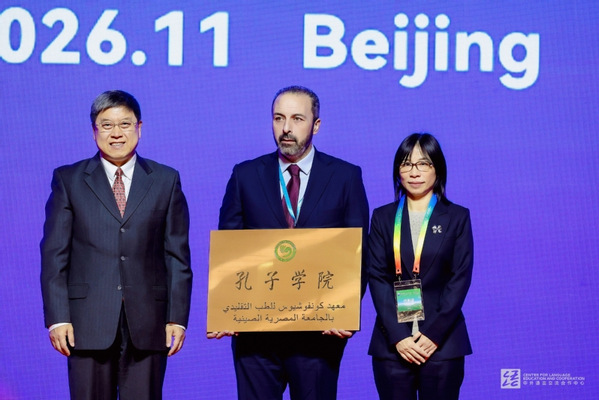
Plaque presentation ceremony
The institute is NJUCM's first Confucius Institute in Egypt. Drawing on the university's strengths in traditional Chinese medicine (TCM), it will feature an integrated "Chinese Language + TCM" approach, combining Chinese language education with the sharing of TCM culture. It aims to cultivate talent with both Chinese language proficiency and a grounding in TCM, while promoting engagement with TCM culture in Egypt and the wider Arab region in ways that respond to local contexts.
NJUCM has now established three Confucius Institutes, located in Australia, Ireland and Egypt. As a founding institution of the Global Alliance of Confucius Institutes for Chinese Medicine, the university has long undertaken organizational and coordination responsibilities for the alliance. It has made significant progress in developing TCM-focused Confucius Institutes, training teachers and creating teaching resources. The university has also compiled a range of textbooks integrating Chinese language learning with TCM, including Chinese for Traditional Chinese Medicine and Chinese Materia Medica in Comics, providing a solid foundation for the new institute's development.
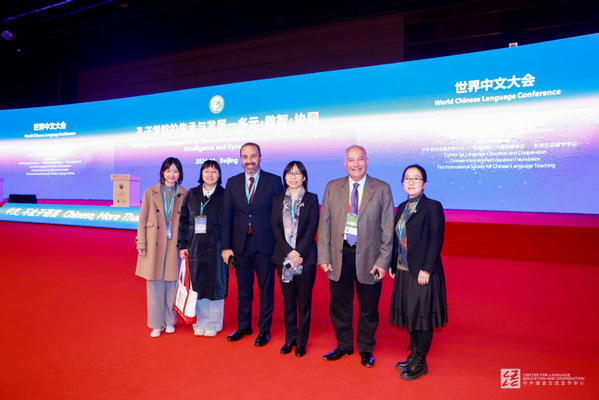
Delegates from NJUCM and ECU at the conference
Representatives from NJUCM's Office of International Cooperation and Exchange also attended the events.
About
Admission
Academics
Research
Distinguished Scholars
Overseas Alumni
Global
Campus Life
Giving
The 2026 World Chinese Language Conference was held in Beijing from November 13 to 14. Vice President of China Han Zheng attended the opening ceremony and delivered an address, offering proposals on strengthening capacity in international Chinese language education, deepening people-to-people ties between China and other countries, promoting mutual learning among civilizations, and enabling the Chinese language to better support international cooperation. Under the theme "Chinese, More Than a Language," the conference brought together approximately 2,000 participants, including government officials, experts, scholars, university leaders and representatives of international organizations from China and abroad.
On November 14, a special session titled "The Inheritance and Development of Confucius Institutes: Diversity, Digital Intelligence and Synergy" took place. Ren Youqun, Vice Minister of Education of China, delivered a keynote address. Zhao Lingshan, Vice President and Secretary-General of the Chinese International Education Foundation (CIEF), chaired the session.
During the plaque presentation ceremony for newly established Confucius Institutes, Feng Yunsheng, Vice President of CIEF and Chairman of China Education Publishing and Media Group, presented the official plaque to the Confucius Institute for Traditional Medicine at the Egyptian Chinese University, jointly established by Nanjing University of Chinese Medicine (NJUCM) and Egyptian Chinese University (ECU). Sun Xiulan, Member of the Standing Committee of the Party Committee and Vice President of NJUCM, and Mahmoud Sabry, Vice Chairman for International Affairs of ECU's Board of Trustees, jointly accepted the plaque on behalf of the two partner universities.

Plaque presentation ceremony
The institute is NJUCM's first Confucius Institute in Egypt. Drawing on the university's strengths in traditional Chinese medicine (TCM), it will feature an integrated "Chinese Language + TCM" approach, combining Chinese language education with the sharing of TCM culture. It aims to cultivate talent with both Chinese language proficiency and a grounding in TCM, while promoting engagement with TCM culture in Egypt and the wider Arab region in ways that respond to local contexts.
NJUCM has now established three Confucius Institutes, located in Australia, Ireland and Egypt. As a founding institution of the Global Alliance of Confucius Institutes for Chinese Medicine, the university has long undertaken organizational and coordination responsibilities for the alliance. It has made significant progress in developing TCM-focused Confucius Institutes, training teachers and creating teaching resources. The university has also compiled a range of textbooks integrating Chinese language learning with TCM, including Chinese for Traditional Chinese Medicine and Chinese Materia Medica in Comics, providing a solid foundation for the new institute's development.

Delegates from NJUCM and ECU at the conference
Representatives from NJUCM's Office of International Cooperation and Exchange also attended the events.